An Intersectional Analysis of Climate Risk and Susceptibility among Urban Schools Across 20 Major U.S. Cities
About
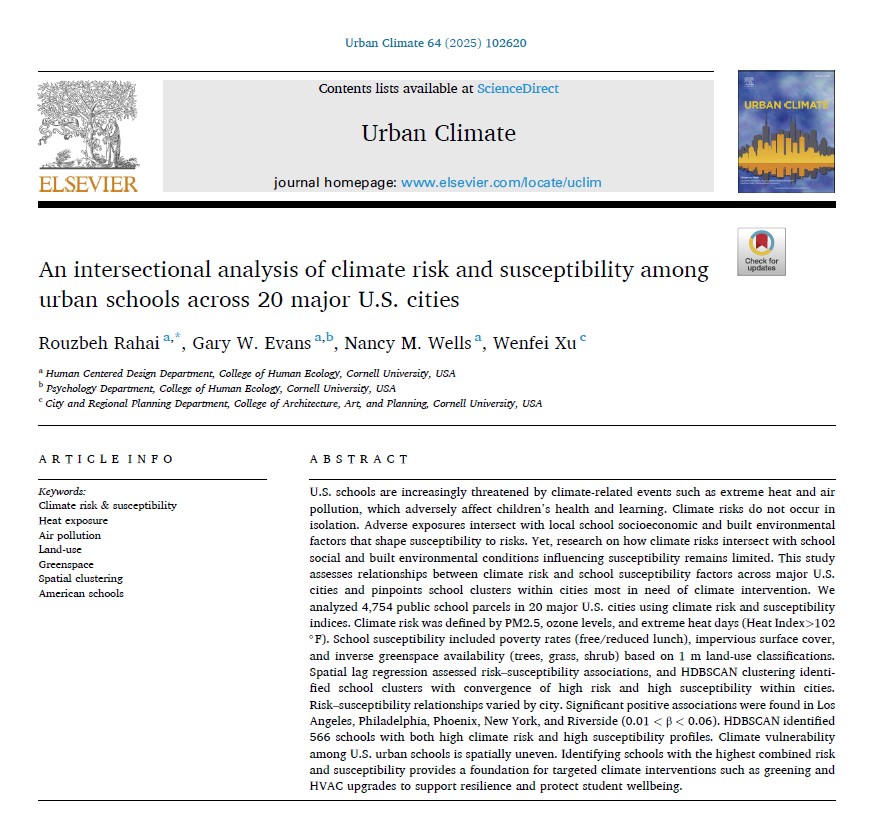
U.S. schools face growing climate-related threats, including extreme heat and air pollution, which harm student health and learning. These risks intersect with socioeconomic and built environmental conditions that shape school-level susceptibility. We analyzed 4,754 public schools across 20 major U.S. cities using climate risk (PM2.5, ozone, extreme heat days >102°F) and susceptibility indicators (poverty, impervious cover, inverse greenspace). Spatial lag regression and HDBSCAN clustering identified city-specific risk–susceptibility relationships, with significant positive associations in Los Angeles, Philadelphia, Phoenix, New York, and Riverside, and 566 schools exhibiting both high risk and high susceptibility. Climate vulnerability is spatially uneven across urban schools, underscoring the need for targeted interventions such as greening and HVAC upgrades to protect student wellbeing.
Read the Paper